

Osmond High-Security Passport Reader: Redefining Trust in Identity Verification
In environments where identity verification must be both fast and highly secure, traditional scanning solutions are no longer sufficient. Industries such as border control, financial services, hospitality, and secure access management require systems that do more than capture data as they must actively validate identity integrity in real time.
The Osmond High-Security Passport Reader, developed by Adaptive Recognition, is designed to meet this demand. It functions as a modern identity verification platform that streamlines document processing while strengthening fraud detection at every stage of capture and analysis.
Built for High-Trust, High-Throughput Environments
Osmond is engineered for operational environments where accuracy and speed must coexist without compromise. It processes a wide range of identity documents, including passports, national IDs, driver’s licenses, and electronic travel documents, making it suitable for both public-sector checkpoints and private-sector onboarding systems.
Rather than functioning as a simple scanner, Osmond acts as a verification endpoint within the identity workflow—supporting rapid decision-making at the point of entry.
Multi-Layered Security Analysis
At the core of Osmond is a multi-spectrum imaging system that evaluates documents using visible, infrared, ultraviolet, and oblique lighting techniques. This allows the device to inspect both overt and embedded security features within official documents.
It performs structured validation across key document zones, cross-checking machine-readable and visual data to detect inconsistencies that may indicate tampering or fraud. This layered approach ensures that verification is not limited to surface-level extraction, but extends into structural authenticity checks.
Intelligent Fraud Detection
Beyond imaging, Osmond applies automated analysis to identify anomalies in print quality, microtext patterns, alignment, and document structure. These checks reduce reliance on manual inspection and improve consistency across operators and environments.
The result is a more stable and repeatable verification process, even under high-volume operational pressure.
Integration Across Software and Network Environments
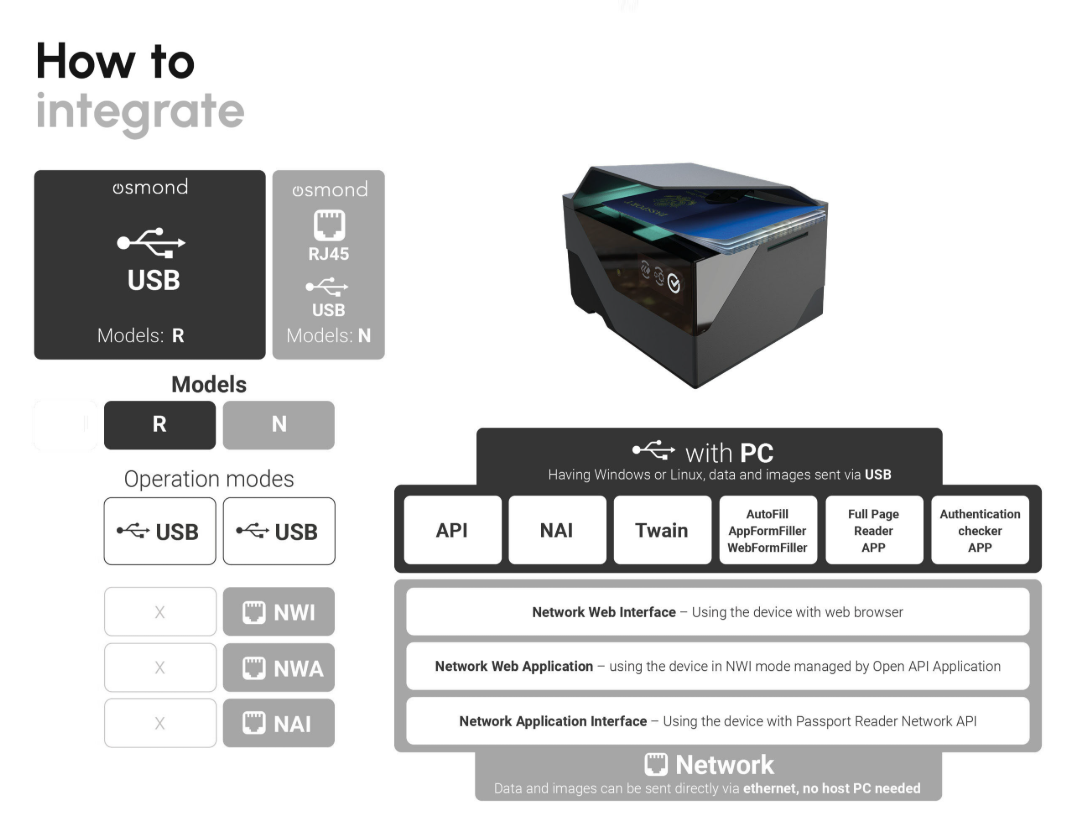
Osmond is designed to integrate flexibly into both traditional and distributed system architectures. It supports USB and Ethernet (RJ45) connectivity and operates across Windows and Linux environments, enabling straightforward deployment in workstation-based setups or networked infrastructures.
In addition to direct device communication, Osmond supports multiple integration layers depending on system complexity:
- API-based integration for direct application-level communication
- Web-based operational modes for browser-accessible deployment
- SDK-driven workflows for embedding identity capture into custom applications
Across all models, Osmond supports core functions such as document reading, authentication, image capture, and structured data extraction, allowing it to scale from single-station deployments to enterprise-wide identity systems.
Engineered for Continuous Operation
Reliability is central to Osmond’s design. The device is built for continuous, high-volume use with minimal maintenance requirements. Its architecture reduces mechanical dependency and supports long-term deployment in environments where downtime directly impacts operational flow and security compliance.
Conclusion
The Osmond High-Security Passport Reader represents a shift from traditional document scanning toward intelligent identity verification infrastructure. By combining multi-layer optical analysis with flexible integration capabilities, it enables organizations to strengthen security while maintaining operational efficiency.
For organizations where identity assurance is critical, Osmond serves as a foundational component in modern verification ecosystems—bridging speed, compliance, and security in a single platform.
